


MONUMENTS IN MILAN
 Milan City Sightseeing Tour including il Cenacolo – Da Vinci's "Last Supper"
Make a panoramic city tour of Milan to see it's major sights such as The Duomo and Sforzesco Castle. This is your opportunity to see Da Vinci's "Last Supper", and enjoy an espresso in the same cafe that composer Verdi frequented.
 Duration: 4 hours
Price: Starting from EUR €60.00 per person
 based on traveler feedback
 |
Santa Maria delle Grazie
This church was built between 1466 and 1490 by Giuniforte Solari and later partly modified by Bramante who re-designed the apse, the Tribuna, the Cloister and the Old Sacristy. In the Refectory there is one of the most famous paintings of Leonardo da Vinci: the “Last Supper”. The works of the fresco started in 1495 and finished in 1498. Unfortunately it started to deteriorate only 20 years after completion, so it had four restorations: in 1908, 1924, 1953 (after the bombings of Second World War) and in 1977. Inside the church there is also the Crucifixion of Donato Montorfano (1495).
Address: Piazza Santa Maria delle Grazie, 2
Phone: 02 89421146
 Leonardo da Vinci Last Supper (Tickets Reservation)
Visit Leonardo da Vinci's masterpiece, The Last Supper (Cenacolo Vinciano, in Italian). In the refectory of the 15th century Church of Santa Maria delle Grazie, is located Leonardo da Vinci's Last Supper, one of the greatest masterpieces in the history of art.
Or visit our section dedicated to Leonardo's Last Supper.
Price: starting from €5.48 per person
 |
Monumental Cemetery
Carlo Maciachini built the Monumental Cemetery between 1863 and 1866 at Porta Volta. The numerous monuments are made by a multitude of artists such as Giacomo Manzù, Luca Beltreami, Pietro Cascella, Mosè Bianchi, Francesco Messina, Medardo Rosso, Adolfo Wildt, Vincenzo Vela and Ettore Ximenes. In this cemetery where important citizens were buried, such as Alessandro Manzoni, Pietro Mascagni, Arrigo Boito, Francesco Hayez, Carlo Forlanini, Maria Callas, Eugenio Montale, Elio Vittoriani, the General Carlo Alberto Dalla Chiesa and many others.
Address: Piazza Cimitero Monumentale, 1
Phone: 02 6599938
 |
Palazzo Reale (Royal Palace)
The Royal Palace is one of the most beautiful architectures of the Milanese 18th century. It was the home of the Visconti and of the Sforza families in the past and later, residence of the Spanish and of the Austrian governors. It was the architect Giuseppe Piermarini (the same who designed La Scala theatre) who renovate the building between 1771 and 1778 giving it the splendid Neoclassical appearance it has today. From 1598 the Royal Palace housed the first permanent theatre in Milan, then destroyed by fire in 1776. In 1965 the city of Milan purchased the palace to use it as offices, museums and for the temporary shows and exhibitions.
Address: Piazza del Duomo, 12
Phone: 02 76316505
 |
Villa Reale (Royal Villa)
One of the most important Milanese neo-classical buildings, the Royal Villa, was built in 1790 by Leopoldo Pollak. It has been the residence of Napolen and Josephine and also of Eugene Beauharnais and the General Radetzky. Pilasters and columns decorate all the building that is surrounded by an English-style garden. The insides are finely decorated with candelabras, sculptures, frescoes and other decorations typical of Lombard neo-classicism.
Address: Via Palestro, 16
Phone: 02 76002819
 |
Torre Branca (Branca Tower)
The Branca Tower is an iron tower situated inside Parco Sempione. With its 108,61 meters high,it is the second higher build in Milan after the Pirellone and the higher panoramic point accessible to visitors in Milan. The tower was designed by Giò Ponti and inaugurated in 1933 under the name of Littoria Tower (it was also called "the tower of the park"), which was then closed to visitors in 1972. After a restructuring ordered by the Branca company, it was reopened to visitors in 2002.
You can visit Branca Tower to see Milan from high!
Book your ticket to Branca Tower.
Price: from € 4.30 (full price)
Address: Via Camoens - Parco Sempione
Phone: 02 3314120
 |
Terraces of the Cathedral
The Terraces on the roof of the cathedral in Milan represent a unique innovation in the construction of cathedral roofs. They have a surface of 8,000 mq which is covered by marble of Condoglia (a particular pit on the Lago Maggiore) continuously maintained. There are 201 steps to climb in order to get to the top and once there, you will have a breathtaking view on the whole city. On the terrace visitors will have the possibility to admire magnificent arches, the 135 pinnacles of the cathedral, the numerous statues (180) and to breath a peaceful atmosphere over this constantly active city, with good weather you can even see the Italian and Switzer Alps. From there you will see the famous "La Madonnina", the gilded copper statue by Giuseppe Perego, symbol of the city and situated on the major spire of the Cathedral.
Address: Duomo - Piazza Duomo, 18
Phone: 02 463456
 |
Sforza Castle
is one of the symbols of Milan together with the Madonnina and the Galleria Vittorio Emanuele II. Built within ten years between 1358 and 1368 under Galeazzo II Visconti. The Castle was partly destroyed in 1447 because of a decision of the Ambrosia Republic, it was rebuilt during Francesco Sforza’s period. The Castle suffered many adversities until 1880 when the government wanted to destroy it. The good sense prevailed and the Castle was restored under Luca Beltrami’s direction. The entrance is situated under the tower of Filarete; on the back you find the Bona di Savoia’s tower and on the left side the Rocchetta, a fortified part inside the Castle useful to get refuge during war attacks. The Rocchetta has a three sides internal portico, and inside its rooms there is the famous Bramante’s “Argus”. The Ducal Court was usually the residence of the lords. One of the rooms of Ducal Court, the “Sala delle Asse” is thought to have been frescoed by Leonardo da Vinci.
Address: Piazza Castello,3
Phone: 02 88463700
 |
Vittorio Emanuele Gallery
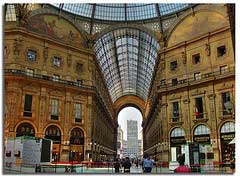
The Vittorio Emanuele Gallery is a covered double arcade formed of two glass-vaulted arcades at right angles intersecting in an octagon, a covered passage that connects Piazza della Scala, Piazza Duomo, Via Silvio Pellico and Via Ugo Foscolo. Named after Vittorio Emanuele II, the first king of united Italy, it was designed by the architect Giuseppe Mengoni in an eclectic style, typical in Milan during the second half of the 19th century. Today, the four-story arcade includes elegants shops selling any kind of object, from haute couture to books, as well as restaurants, cafés and bars. The Gallery, together with Via Montenapoleone and Via della Spiga is considered to be one of the main centers for shopping in Milan. It is one of the most beautiful covered galleries in Europe.
 |
Arch of Peace
The works for arch construction started in 1806 thanks to Luigi Cagnola, who was asked by Napoleon to build a celebrative arch. After Napoleon’s defeat of Waterloo, the arch was not completed and in 1826 Franz I of Austria ordered to finish the construction with some alternations, because he wanted to dedicate the Arch to the European Peace reached in 1815. When Cagnola died in 1833, the Arch was finished by Francesco Peverelli and Francesco Londonio. It was inaugurated on September 10th, 1838 by the Emperor Ferdinand I of Austria.
 |
Piazza Mercanti
Very close to Piazza Duomo there is Piazza Mercanti. In this square the Palazzo della Ragione is situated, also called Borlotto Nuovo, the symbol of Milanese communal period. In the opposite side there is the Loggia degli Osii: built in black and white marble, was commissioned by Matteo Visconti in 1316. Next to the Loggia there is the Palazzo delle Scuole Palatine, designed by Carlo Buzzi and built between 1644 and 1645. At the end of the square there is the Status Office, built over the remains of Panigarola House (XV century). This place is called the “Medieval Heart” of the city.
Arena
The Arena, also called Stadium, is situated very close to the Sforza Castle. It was built in 1806 thanks to Luigi Canonica using the rests of the old castle fortifications. It was also used as a theatre or it was flooded with water of the Navigli to stage sea-battles.
 |
PALACES IN MILAN
 |
Palazzo Marino
This palazzo was named after a person who commissioned its building that started in 1553 and finished in 1558. It was designed by the well-known architect Galeazzo Alessi. Inside the palazzo, which is situated in Piazza della Scala, is full of monuments, statues and paintings, as well as a beautiful inner courtyard. Now Palazzo Marino hosts the Town Hall.
 |
Palazzo Isimbardi
In Corso Manforte 35 there is Palazzo Isimbardi, a XV century building enlarged and modified through the years. Many rooms inside were painted by Tiepolo and other painters. Now it hosts the Disctrict Council.

Palazzo del Senato
Firstly built during the Napoleonic period in 1620 for the Swiss College by Fabio Mangone, it was the Senate House of the Kingdom of Italy. Now, in this palazzo in Via Senato 10, there are the State Archives.
 |
Palazzo Dugnani
Situated in Via Manin 2, Palzzo Dugnani now houses the Cinema Museum. It was built in the XVII century and has frescoes by Tiepolo, Ferdinando Porta and the Venetian school.
 |
Palazzo di Brera
In Via Brera 28, there is the impressive Palazzo di Brera. Its construction started in 1651 but ended only in 1773. In 1780 Piermarini added a great portal. The inside courtyard is decorated by arches and columns and in the middle Antonio Canova’s bronze statue of Napoleon (1811). Now the palazzo is the seat of the Brera Art Gallery, the Brera Library, the Academy of Fine Arts, as well as the Astronomical Observatory.
Palazzo del Governo
It is a great neoclassical building in Corso Manforte 31. It was modified many times by its owners from the XVII century. The façade was designed by Piero Gilardoni in 1817. Since 1859 it has been hosting the Milan District Prefecture.
Palazzo Bagatti Valsecchi
You can find this fine example of neo-Renaissance in Via Santo Spirito 7-10. It was built in the XIX century as a museum-home. The part at no. 7 was built in 1859 in Lombard style of the XV century. The other part (1882) was built reflecting the XVI century architecture.
 |
Palazzo Castiglioni
In Corso Venezia 47 there is the first example of Art Nouveau building, Palazzo Castiglioni. It was designed in 1903 by Sommaruga and has particular decorations belonging to the “Floreale” style.
 |
Palazzo delle Stelline
Built in the XVII century, the Palazzo delle Stelline was the monastery of the Disciples of Santa Maria della Stella at the beginning. Then there was founded a former girls’ orphanage. This building is situated in Corso Magenta 61.
 |
House of Omenoni
Not so far from Piazza della Scala, in Via Omenoni 3, this palazzo has a great façade decorated by Antonio Abondio who sculpted on the front of the house the eight “Omenoni”. The house was built in 1565. Inside there is a nice courtyard decorated with a colonnade.
 |
Palazzo Litta
Built in the baroque and rococo styles in 1648, Palazzo Litta is in Corso Magenta 24. It is characterized by a XVII courtyard with double columns, it has a fine Louis XV apartment inside.
 |
Pirelli Skyscraper (Pirellone)
The other symbol of Milan, together with the Madonnina, the “Pirellone” is one of the tallest buildings in the world built in reinforced concrete. It was built between 1955 and 1959 in piazza Duca d’Aosta, near the Central Railway Station.


 Facebook
 Twitter
 Flickr
 Our Blog