


FAMOUS PEOPLE OF MILAN
Many leading personalities of the Italian cultural life- intellectuals, journalists, politicians, composers or authors- have a connection to Milan.
The novelist Alessandro Manzoni (1785 – 1873) was born in Milan and many others came here to find their 'lucky break' (like Giuseppe Verdi) or to work. The most wide-spread and fitting opinion of Milan is that this city is open-minded, hospitable and welcomes its visitors sincerely even if it sometimes seems to be a bit curt.
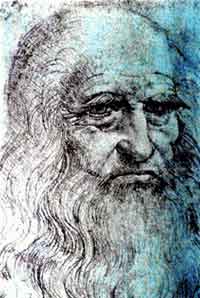
Leonardo da Vinci (1452 – 1519)
Lodovico il Moro invited him
to come to his house in 1482 and Leonardo da Vinci stayed there
for almost 20 years. He left many of his artworks, e.g. Codex Atlanticus,
which is now at the Biblioteca Ambrosiana, and the Last Supper- in
the church Santa Maria delle Grazie. Born in
Vinci, just outside Florence, on April 15, 1452, Leonardo was the illegitimate son
of a 25–year–old notary, Ser Piero, and a peasant girl, Caterina.
Growing up in his father's home in Vinci, Leonardo had access to scholarly
texts and was also exposed to Vinci's longstanding painting tradition. When he was about 15 his father apprenticed him to the renowned
workshop of Andrea del Verrochio in Florence, where he was an apprentice
until 1477 when he made a home for himself.
In search of new challenges and money, he entered the service of
the Duke of Milan in 1482, abandoning his first commission in Florence,
"The Adoration of the Magi.". He spent 17 years in Milan,
leaving only after Duke Ludovico Sforza's fall from power in 1499.
For further information about Leonardo Da Vinci visit:
http://www.aboutflorence.com/florentine-famous-people.html#leonardodavinci
It was
during these years that Leonardo reached new heights of scientific and
artistic achievement, painting and sculpting as well as designing elaborate
court festivals, weapons, buildings and machinery. His
studies from this period contain designs for advanced weapons, including
a tank and other war vehicles, various combat devices, and submarines.
Also during this period, Leonardo produced his first anatomical studies.
After the invasion by the French and Ludovico Sforza's fall from power
in 1499, Leonardo was left to search for a new patron and over the next
16 years, Leonardo worked and traveled throughout Italy for a number
of employers. About 1503, Leonardo reportedly began work on the "Mona
Lisa".
From 1513 to 1516, he worked in Rome, maintaining a workshop and undertaking
a variety of projects for the Pope. He continued his studies of human
anatomy and physiology, but the Pope forbade him from dissecting cadavers.
Following the death of his patron Giuliano de' Medici in March 1516,
he was offered the title of Premier Painter and Engineer and Architect
of the King by Francis I in France. Although suffering from a paralysis
of the right hand, Leonardo was still able to draw and teach. He produced
studies for the Virgin Mary from "The Virgin and Child with St.
Anne", studies of cats, horses, dragons, St. George, anatomical
studies, studies on the nature of water, drawings of the Deluge, and
of various machines.
Leonardo died on May 2, 1519 in Cloux, France. Legend has it that King
Francis was at his side when he died, cradling Leonardo's head in his
arms.
 Find here detailed information about the Last Supper, masterpiece of Leonardo da Vinci.
Book your visit to Leonardo da Vinci's Last Supper and to the Cenacolo.

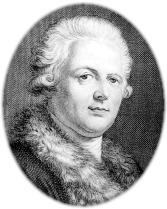
Pietro Verri (1728 – 1797)
was born in Milan in 1728 into a noble and conservative family. He spent his youth in various religious institutes until 1749 when he started to rebel against the environment in which he was brought up. Dismayed at his father's decision to make him take up law studies, he left in 1759 to sign up as a volunteer in the Seven Years War. However, unable to put up with military life, he left the following year. Back in Milan, together with his brother Alessandro, Paolo Frisi, Cesare Beccaria, Carli and Secchi, he set up an academy, 'la Accademia dei Pugni', for which, from 1764 to 1766, he edited the periodical “Il Caffè”. This Illuministic publication was one of the most lively and innovative in Milan. This was a period of fervid work for Verri, when, apart from the magazine, he wrote various other works including "Il Discorso sulla felicità" (1763). When the group broke up, Verri started working for the Austrian administration, a job which brought him no satisfaction (in both a personal and idealistic point of view) despite the fact that in this period he had started writing a great deal again. The outbreak of the French Revolution rekindled his hopes and the Napoleonic invasion led him to take up a post in the provisional Municipality in spite of its lack of Jacobean ideals.
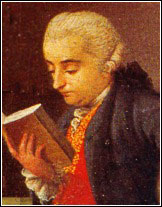
Cesare Beccaria (1738 – 1794)
Beccaria was a literate and a philosopher, a jurist and an economist, and above all- one of the most important exponents of the Italian Enlightenment. At the plaza which is named after him there is a statue in his honour. He was born in Milan into an old noble family. He graduated in law and spent his life in Milan were he frequented the "Accademia dei Pugni", environment culturally rich and very fashionable, collaborating also with the famous newspaper "Il Caffé". With the help of Pietro Verri, one of the founders of the academia, in 1764 he reached to write and publish in less than a year his most famous work, "On Crimes and Punishments", which is also one of the most significant works of this period of important cultural transformations. His book had a great success in the whole Europe, and especially in France, where he began to travel after an invitation by French Intelluctuals. But he did not fit in this kind of life and he always returned to Milan, where he spent the rest of his life and where he later died in 1794. Cesare Beccaria was one of the most important catalysts and supporters of the reform movement against continental criminal law which was characterized all over Europe for its extreme cruelty and lack of reason; he had also an important role in the widely spread Enlightenment Reform of XVIII century, inspired in the ideals of autonomy, enfranchising and war against oppressors.
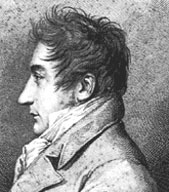

Alessandro Manzoni (1785 – 1873)
His father, Pietro Manzoni, was a rich land owner from Lecco, and his mother, Giulia Beccaria, was daughter of the famous jurist Cesare Beccaria. He attended various catholic schools and his early works were characterized by a strong anticlerical theme and strong support for democratic and Jacobean ideals. He lived in Paris until 1810, when he returned to Italy and married Enrichetta Blondel. His most productive period as a writer was between 1812 and 1815 when he started writing "Inni Sacri" which he finished in 1822 with the final piece, "La Pentecoste". Between 1820 and 1822 he finished two tragedies, "Il Conte di Carmagnola" and "L’Adelchi". In his theoretical writings of these years he developed ideas which would later reappear in "Promessi Sposi" (1821–1842). After 1842 he devoted his time almost exclusively to literary theory essays. He was nominated senator of the new Italian Kingdom in 1861 and was assigned the presidency of the commission for the unification of the Italian language.He died in 1873 after having received his Roman citizenship in recognition of his work for Italian unification. Manzoni wrote "The Fincancés", which is the most significant Italian novel, as well as dramas and lyrics. His house at the Piazza Belgioioso is open for visitors.

Giuseppe Verdi (1813 – 1901)
He specialized in opera and became the most famous italian composer of the Romanticism period.
He was born in Busseto in the
province of Parma and came to Milan when he was very young. He soon developed
an inclination to music, his first teacher was Pietro Baistrocchi,
Roncole organist. His
third opera "Nabucco" (1842) brought him into the limelight.
When he came back to Busseto he was appointed music composer of the
municipality and conductor of the orchestra.
In 1835 he married his patron's daughter Margherita Barezzi who
died together with their two children during the 1838-1840 years
in Milan, where the Verdi family had moved.
His first opera to be successfully performed at the Scala Theatre in Milan was "Oberto Conte di San Bonifacio" in 1839.
Giuseppe Verdi died in Milan on the 27th of the January 1901 and
he was burried in the Home for Musicians he himself founded. He
died in The Grand Hotel et de Milan where he lived.

Carlo Emilio Gadda (1893 – 1973)
Born in Milan, he was one of the great authors of the 20th century. One of his main works is "L’Adalgisa", which shows the life from average people of Milan. Gadda worked for many years in Italy and abroad as an electrical engineer; he was seen for most of his career as a difficult and obscure author. Much of his work consists of short stories, novel fragments, and essays written in the 1920s, 1930s, and 1940s, originally published in elite literary journals such as the Florentine Solaria and Letteratura and appreciated by a small coterie of critics and literati. He kept writing until his death, in 1973.

Giorgio Strehler (1921 – 1997)
In 1947 the great director who was born in Trieste founded together with Paolo Grassi the Piccolo Teatro della Città di Milano, the first permanent theatre in Italy. He was a passionate and innovative director. He also directed operas at La Scala, played the title role in his own epic production of Goethe's Faust, and served one term (1987–92) in the Italian Senate.

Bramante (1444 – 1514)
Pseudonym of Donato di Angelo di Pascuccio, he was the greatest architect of the High Renaissance. He probably trained in Urbino and is first documented in 1477 working on fresco decorations at the Palazzo del Podestá in Bergamo. In about 1480 he settled in Milan. He did many architectural works (S. Maria presso S. Satiro, S. Maria delle Grazie, cloisters of S. Ambrogio),but it was his painting that influenced the Lombard school. The Brera Gallery houses the repositioned frescos of Men–at–Arms and the wood panel Christ at the Column. This is the only panel that can definitely be attributed to Bramante. The Sforza Castle contains his symbolic fresco Argus. Bramante left Milan after the fall of Ludovico Sforza (il Moro) and settled in Rome in 1499. Here he started his extraordinary reinterpretation of antiquity (the small temple next to S. Pietro in Montorio left a deep impression on the artists). Within a few years he had become the most important architect at the papal court. For Pope Julius II he undertook the overall redesign of the Vatican Palaces around the Belvedere courtyard. From 1506 he did fundamental work on rebuilding St. Peter's which was later to be carried on by Michelangelo.

The family Visconti
Ruled Milan from the 13th century until 1447. In the 12th century members of the family received the title of viscount, from which the name is derived. Ottone Visconti, 1207–95, was archbishop of Milan and after he had defeated the opposition of the Della Torre family he was recognized (1277) as lord of the city. Giovanni Visconti, 1290–1354, took over the government in 1349. At his death the Milanese possessions were divided into his three nephews, Matteo II, Galeazzo II, and Bernabo. After ruling over years and changing the power from family member to family member, Bianca Maria, the daughter of Filippo Maria Visconti, married Francesco I Sforza.

Ascanio Maria Sforza
a member of the Sforza family and
son of Francesco Sforza, was a cardinal of the Roman Catholic Church
and also a patron of the arts. He lived from 1455 to1505. He secured
the election of Rodrigo Borgia (Pope Alexander VI) as pope. The
Family Sforza is an Italian family that ruled the duchy of Milan
from 1450 to 1535. The used this military position to become rulers
in Milan. The family governed by force, tricks and power politics.
Under their rule the city–state flourished and expanded.


 Facebook
 Twitter
 Flickr
 Our Blog